NEW CERTIFICATE HOLDER: JUL – DEC 2025

NEW CERTIFICATE HOLDER

LEVEL TWO

H252040 Certified Internal Family Systems Psycho-hypnotherapist (Science Based) Cheong Wai Peng, Bing
H252041 Certified Internal Family Systems Psycho-hypnotherapist (Science Based) Cheung Hon Wing
H252042 Certified Internal Family Systems Psycho-hypnotherapist (Science Based) Ching Pui Kwan
H252043 Certified Internal Family Systems Psycho-hypnotherapist (Science Based) CHOI CHI HO
H252044 Certified Internal Family Systems Psycho-hypnotherapist (Science Based) Chow King Kiu
H252045 Certified Internal Family Systems Psycho-hypnotherapist (Science Based) Leung Miu Yin
H252046 Certified Internal Family Systems Psycho-hypnotherapist (Science Based) Lui Wing Yee
H252047 Certified Internal Family Systems Psycho-hypnotherapist (Science Based) Mable Wong
H252048 Certified Internal Family Systems Psycho-hypnotherapist (Science Based) POON LOK KEI, ROCKY
H252049 Certified Internal Family Systems Psycho-hypnotherapist (Science Based) Poon Man-Chi, Sam
H252050 Certified Internal Family Systems Psycho-hypnotherapist (Science Based) Tsoi Hiu-kwan
H252051 Certified Reminiscence and Hospice Service Hypnotist (Psychological Oriented) Chan Hui Wa Dara
H252052 Certified Reminiscence and Hospice Service Hypnotist (Psychological Oriented) Chan Yuen Kei
H252053 Certified Reminiscence and Hospice Service Hypnotist (Psychological Oriented) Chiu Kit Ying
H252054 Certified Reminiscence and Hospice Service Hypnotist (Psychological Oriented) Chiu Sing Hei Summy
H252055 Certified Reminiscence and Hospice Service Hypnotist (Psychological Oriented) CHOI CHI HO
H252056 Certified Reminiscence and Hospice Service Hypnotist (Psychological Oriented) Leung Miu Yin
H252057 Certified Reminiscence and Hospice Service Hypnotist (Psychological Oriented) LI CHUNG SHUN
H252058 Certified Reminiscence and Hospice Service Hypnotist (Psychological Oriented) Mable Wong
H252059 Certified Reminiscence and Hospice Service Hypnotist (Psychological Oriented) Ng Suk Fong
H252060 Certified Reminiscence and Hospice Service Hypnotist (Psychological Oriented) Poon Man-Chi, Sam
H252061 Certified Reminiscence and Hospice Service Hypnotist (Psychological Oriented) Wong Pui Yee
H252062 Certified Stress and Insomnia Relief Psycho-hypnotherapist (Science Based) Chiu Sung Hei Summy
H252063 Certified Stress and Insomnia Relief Psycho-hypnotherapist (Science Based) LAM PAK FUNG
H252064 Certified Stress and Insomnia Relief Psycho-hypnotherapist (Science Based) Lisa Lei
H252065 Certified Stress and Insomnia Relief Psycho-hypnotherapist (Science Based) LUI Ka Lok Gilbert
H252066 Certified Stress and Insomnia Relief Psycho-hypnotherapist (Science Based) Mable Wong
H252067 Certified Stress and Insomnia Relief Psycho-hypnotherapist (Science Based) Ng Ka Wai Garvey
H252068 Certified Stress and Insomnia Relief Psycho-hypnotherapist (Science Based) Yam Yuen Ha
H262001 Certified Clinical Hypnotherapist (Psychological Oriented) Chao Si Man
H262002 Certified Clinical Hypnotherapist (Psychological Oriented) CHOI CHI HO
H262003 Certified Clinical Hypnotherapist (Psychological Oriented) Leung Miu Yin
H262004 Certified Clinical Hypnotherapist (Psychological Oriented) Lisa Lei
H262005 Certified Clinical Hypnotherapist (Psychological Oriented) Ng Suk Fong
H262006 Certified Clinical Hypnotherapist (Psychological Oriented) Sze Man Leung
H262007 Certified Clinical Hypnotherapist (Psychological Oriented) Tse Shuk Kam

LEVEL THREE

H263001 Certified Clinical Stress and Insomnia Relief Hypnotherapist(Psychological Oriented) Ng Suk Fong

LEVEL FOUR

H254019 Accredited Paediatric Internal Family Systems Psychotherapist (Specialized in Hypnotherapy) Cheong Wai Peng, Bing
H254020 Accredited Paediatric Internal Family Systems Psychotherapist (Specialized in Hypnotherapy) Cheung Hon Wing
H254021 Accredited Paediatric Internal Family Systems Psychotherapist (Specialized in Hypnotherapy) CHOI CHI HO
H254022 Accredited Paediatric Internal Family Systems Psychotherapist (Specialized in Hypnotherapy) Lui Wing Yee
H254023 Accredited Paediatric Internal Family Systems Psychotherapist (Specialized in Hypnotherapy) Mable Wong
H254024 Accredited Paediatric Internal Family Systems Psychotherapist (Specialized in Hypnotherapy) POON LOK KEI, ROCKY
H254025 Accredited Paediatric Internal Family Systems Psychotherapist (Specialized in Hypnotherapy) Poon Man-Chi, Sam
H254026 Accredited Bereavement Internal Family Systems Psychotherapist (Specialized in Hypnotherapy) Chiu Sing Hei Summy
H254027 Accredited Bereavement Internal Family Systems Psychotherapist (Specialized in Hypnotherapy) CHOI CHI HO
H254028 Accredited Bereavement Internal Family Systems Psychotherapist (Specialized in Hypnotherapy) Leung Miu Yin
H254029 Accredited Bereavement Internal Family Systems Psychotherapist (Specialized in Hypnotherapy) Mable Wong
H254030 Accredited Bereavement Internal Family Systems Psychotherapist (Specialized in Hypnotherapy) Ng Suk Fong
H254031 Accredited Bereavement Internal Family Systems Psychotherapist (Specialized in Hypnotherapy) Poon Man-Chi, Sam
H254032 Accredited Caregiver Interpersonal Rehabilitation Psychotherapist (Specialized in Hypnotherapy) Chiu Kit Ying
H254033 Accredited Caregiver Interpersonal Rehabilitation Psychotherapist (Specialized in Hypnotherapy) Chiu Sing Hei Summy
H254034 Accredited Caregiver Interpersonal Rehabilitation Psychotherapist (Specialized in Hypnotherapy) CHOI CHI HO
H254035 Accredited Caregiver Interpersonal Rehabilitation Psychotherapist (Specialized in Hypnotherapy) Leung Miu Yin
H254036 Accredited Caregiver Interpersonal Rehabilitation Psychotherapist (Specialized in Hypnotherapy) Ng Suk Fong
H254037 Accredited Caregiver Interpersonal Rehabilitation Psychotherapist (Specialized in Hypnotherapy) Poon Man-Chi, Sam
H254038 Accredited Internal Family Systems Hypnotic Coach (Psychological Oriented) Mable Wong

Congratulations to the 2025 Youth Hypnosis Mental Health Advocates!

Youth Hypnosis Mental Health Ambassadors are middle school students (Grades 8–11) who have completed mental health training.
Youth Hypnosis Mental Health Advocates are Youth Hypnosis Mental Health Ambassadors who have completed training to promote mental health knowledge to their peers within their schools, creating a healthier psychological environment for themselves and their classmates.
The list of advocates is shown below (in alphabetical order by school name):


School: Elegantia College
Advocates: Huang Lee Nga, Ma Kan Huen, Yu Wing Yin Queena

Promotional Services:
Over the past few months, we’ve experimented with sharing insights during morning meetings. We discussed causes of insomnia stemming from excessive stress and ways to regulate sleep—such as establishing a consistent sleep schedule and ensuring a quiet, comfortable environment for rest. We also covered sleep debt and the benefits of adequate sleep.
Additionally, we wrote morning readings centered on emotions, briefly explaining their connection to sleep and stress. We also outlined three steps for emotional management: accepting and understanding emotions, regulating and expressing emotions, and utilizing and reflecting on emotions to transform them into a force for growth. Finally, we discussed how to comfort classmates affected by their emotions.
Beyond these topics, we hosted an activity using games to convey key lessons. The first game was an Emotion Drawing Relay Challenge. We provided various images, and students took turns acting out the scene depicted in the picture, drawing it, and then describing the emotions shown. This demonstrated how each student interpreted the same scene differently, highlighting the diversity of emotions and the varied ways we understand and express them.
Another game was “Test Your Hidden Personality.” Each question offered four choices, each corresponding to one of four personality types: Dominant, Influential, Compliant, and Steady. This helped students recognize that each personality type has unique approaches and strengths. Different personalities can complement each other—there’s no inherent good or bad—and students can learn to flexibly utilize their own traits.
While promoting mental health information, we also deepened our understanding of sleep, stress, emotions, and related topics.


School: Helen Liang Memorial Secondary School (Shatin)
Advocates: Mak Chiara, Mak Hoi Ying

Promotional Services:
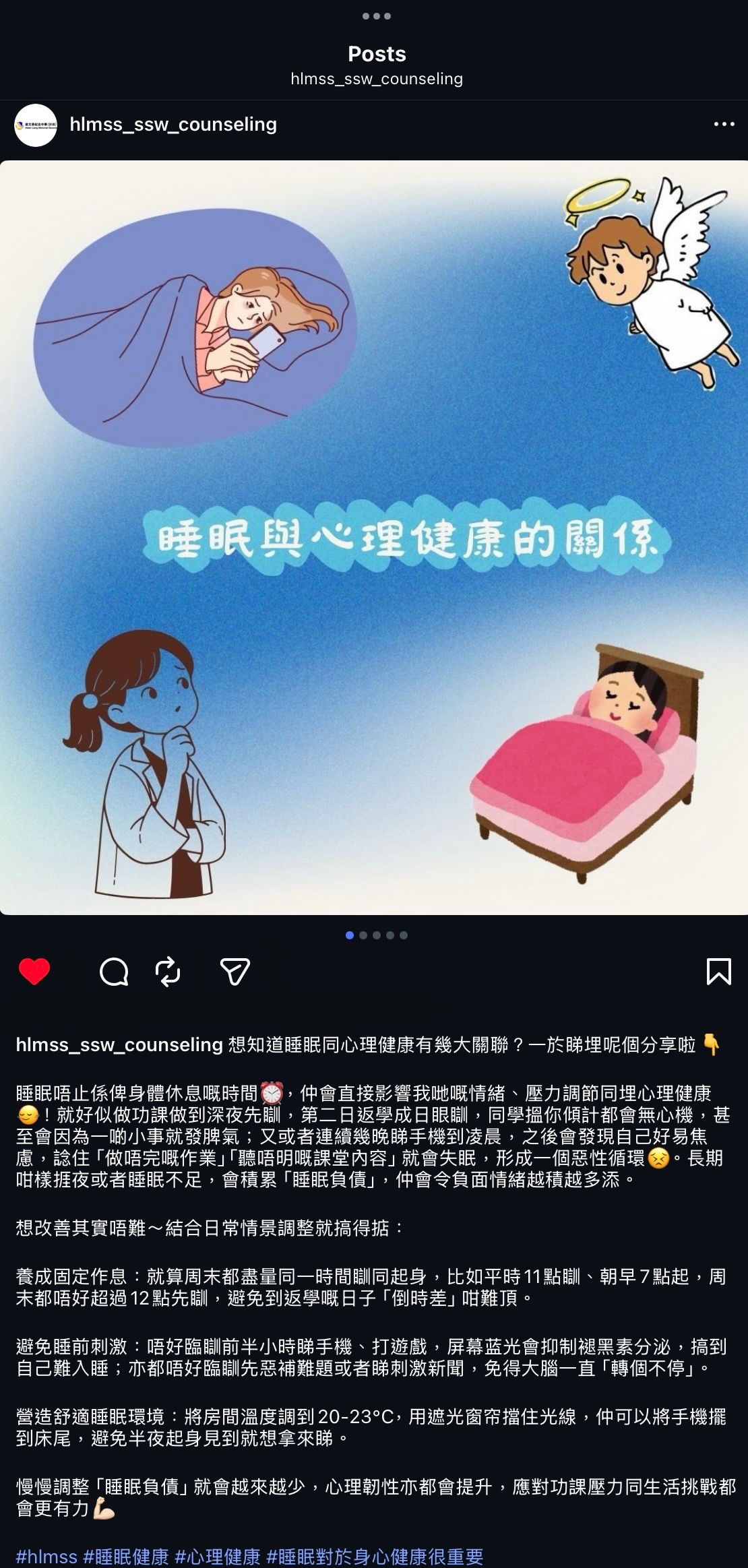
This campus promotion centers on the core theme of “Sleep and Mental Health,” focusing on sleep debt through accessible science communication and sharing. Promotion primarily leverages two channels: the school’s Instagram account and the school newsletter. First, we engage students by relating to everyday scenarios, explaining simply that sleep debt is the health debt accumulated from chronic sleep deprivation—small deficits that add up to harm both body and mind. Next, we clearly outlined its specific harms: not only does it cause daytime fatigue and diminished classroom focus, but it also disrupts emotional stability, intensifies anxiety and irritability, and impacts mental health. We hope to use relatable, everyday examples to help students deeply grasp the close connection between sleep and mental health. This understanding will encourage them to prioritize regular sleep and develop healthy sleep habits. Adequate sleep strengthens both physical and mental well-being, enhances psychological resilience, and enables students to better engage in campus learning and life.


School: HKSYC&IA Chan Nam Chong Memorial College
Advocates: Lam Sze Yu, Suen Cho Wing

Promotional Services:
For this “campus promotion,” we featured our internal stress management team—Firefighters vs. Administrators—during the school TV station’s morning assembly broadcast. We explained that when facing stress, we actually have two inner helpers: “Firefighters” immediately extinguish the flames with quick fixes like gaming or snacking, temporarily easing unease; while ‘Administrators’ prompt us to pause, take deep breaths, and rationally consider, “Is this behavior beneficial for me?” Understanding the protective intent behind each behavior, we learn to collaborate with ourselves rather than fight against ourselves, because every inner voice carries goodwill. Everyone possesses the capacity for self-healing. By learning to listen to our inner voices and treat ourselves kindly, inner chaos will eventually give way to clarity and order. Let’s learn together the wisdom of peacefully coexisting with stress! Therefore, we introduced students to some stress management techniques.


School: Ho Lap College (Sponsored By Sik Sik Yuen)
Advocates: Ho Chantal Ka Ki, Siu Pak Lam, Wong Kam Tim

Promotional Services:
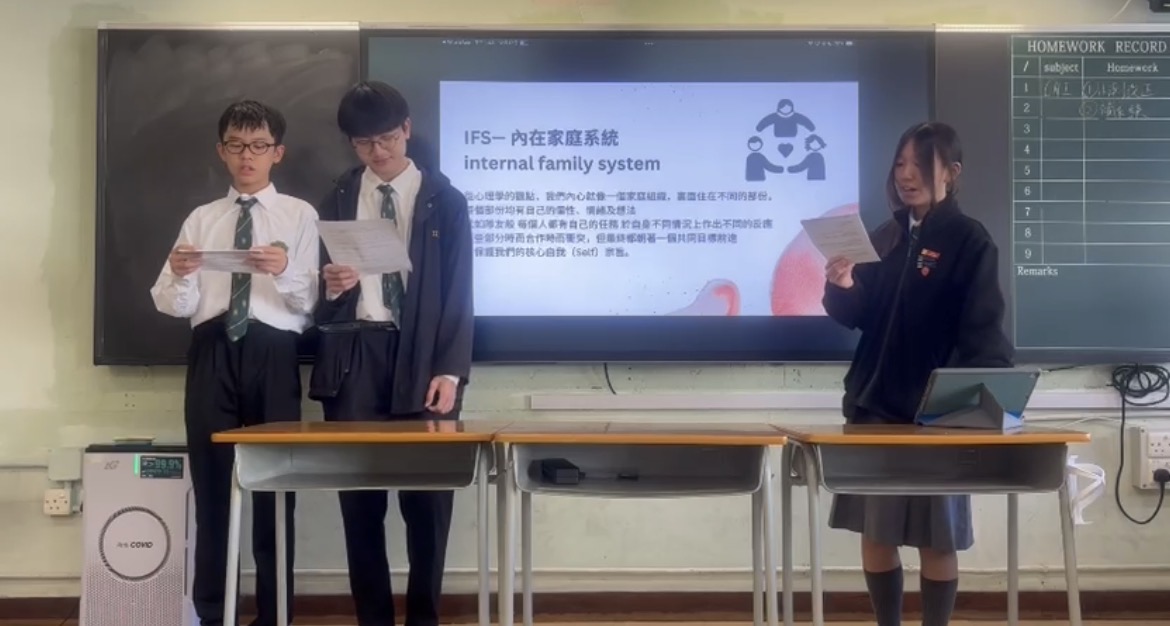
This on-campus promotional event is to introduce the concept of IFS (Internal Family System) in psychology. We hope to introduce this concept because we’ve noticed that many students don’t know why they have certain thoughts or emotions, and even feel strange about themselves, which leads them to put themselves down. So we really hope to introduce this concept we learned in this program to them. In fact, we encounter this situation in many everyday scenarios, and it’s closely related to our IFS system. After this promotional period, we also checked in with the different students and found that they really weren’t as resistant to and skeptical of their own feelings as they used to be. We really hope that they will continue to remember this concept in the future, to accept the parts of themselves that are influencing them.


School: SKH Bishop Mok Sau Tseng Secondary School
Advocates: Au Bik Sum, Chau Ka Ying, Fong Wing Yin

Promotional Services:
We are Secondary School Mental Health Ambassadors. Through participating in the “Secondary School Students Mental Health Ambassador Program 2025,” we received professional mental health training, learning how to manage emotions, reduce stress, and improve sleep quality. To share our knowledge with our school community, we designed a special campus outreach event centered on the theme of “sleep debt.” We introduced our peers to the relationship between sleep and stress, the principles of biological clock function, and the impact of sleep deprivation on physical and mental health.
The event featured interactive lectures, case studies, calculation exercises, and self-assessment tools to help students understand their sleep patterns and learn how to calculate their daily sleep debt. We also shared five key strategies for improving sleep quality: avoiding electronic devices, creating a comfortable sleep environment, choosing sleep-promoting foods, reducing caffeine intake, and practicing meditation for relaxation.
Through this initiative, we aim to raise awareness about sleep health, encouraging students to establish regular routines and enhance their quality of life. We believe that by prioritizing sleep starting tonight, everyone can gradually repay their “sleep debt” and move toward a healthier, happier campus life.


School: St. Rose of Lima’s College
Advocates: Lam Sze Ching Kelly, Law Tsz Yau

Promotional Services:
For our campus outreach, we chose to publish an article titled “Mental Growth, Sleep in Tandem” in the school magazine Rosalima No. 12 to raise students’ awareness of mental health and sleep quality. In the article, we first outlined the current situation of secondary school students, helping peers understand the importance of a healthy mental state and quality sleep, while also explaining our motivation for writing this piece. Next, we briefly shared our reflections and insights from participating in a four-day in-person mental health workshop over the summer break, using our personal experiences to inspire others. We then specifically introduced knowledge learned in class: insufficient sleep creates a gap between the “wakefulness rhythm” and “biological rhythm,” forming the concept of “sleep debt.” This concept highlights the impact of inadequate sleep on the mind, body, and spirit. Simultaneously, we provided practical methods to remind students to improve sleep quality and realign their “wakefulness rhythm” and “biological rhythm” through daily habits like scheduling consistent routines and avoiding electronic devices before bed. Concluding the article, we offered a message to all students, encouraging them to start paying attention to their sleep quality today as a crucial step toward maintaining mental well-being. Looking ahead, after this publication is printed and distributed to all students, we plan to produce a promotional video. This video will introduce the article and share mental health knowledge in a more engaging format. It will also be uploaded to the school’s social media platforms to further promote the importance of mental health.

Efficacy of hypnotherapy in the treatment of irritable bowel syndrome (IBS): a systematic review and meta-analysis

American Journal of Clinical Hypnosis
16-12-2025
Source hyperlink

Efficacy of hypnotherapy in the treatment of irritable bowel syndrome (IBS): a systematic review and meta-analysis

This report outlines the findings of a comprehensive systematic review and meta-analysis published in mid-December 2025. The study aimed to evaluate the definitive efficacy of hypnotherapy as a management strategy for Irritable Bowel Syndrome (IBS), a functional gastrointestinal disorder that affects a significant portion of the global population.

Analyzing data from 16 randomized controlled trials (RCTs), the researchers found compelling evidence supporting the use of gut-directed hypnotherapy. The review highlighted that between 40% and 81% of subjects experienced significant improvement in abdominal symptoms after undergoing hypnotherapy.

A key finding of this 2025 report is the cost-effectiveness and accessibility of the treatment:

“Group hypnotherapy frequently matches individual sessions in terms of efficiency.”

The study further noted that the treatment had a low dropout rate (pooled rate of 8.0%), indicating high patient tolerance. Beyond physical symptom relief, the therapy was associated with significant improvements in quality of life and reductions in anxiety and depression symptoms often comorbid with IBS. The report concludes that hypnotherapy should be considered a primary, effective, and tolerable intervention for IBS.

Self-Guided Hypnosis Significantly Reduces Menopausal Hot Flashes

Baylor University News
11-11-2025
Source hyperlink

Self-Guided Hypnosis Significantly Reduces Menopausal Hot Flashes

This report highlights the results of a multicenter randomized clinical trial led by Baylor University’s Mind-Body Medicine Research Laboratory, published in JAMA Network Open in late 2025. The study addressed a critical need for non-hormonal treatments for menopausal symptoms, specifically for women who cannot take hormone replacement therapy (HRT) due to health history (such as breast cancer survivors).

The trial compared a “self-guided hypnosis” program against a sham control group (listening to white noise). Participants in the hypnosis group utilized a 6-week audio program designed to induce relaxation and coolness.

The findings were statistically significant:

“After six weeks of daily self-hypnosis audio recordings, participants reported a 53.4% reduction in both frequency and intensity of hot flashes.”

Furthermore, the benefits appeared to increase over time. At the 3-month follow-up mark, the reduction in symptoms for the hypnosis group improved to 60.9%, compared to only a ~40% placebo response in the control group. Lead researcher Dr. Gary R. Elkins noted that this study is a “major breakthrough” because it demonstrates that women can effectively learn and apply these techniques on their own without needing daily therapist visits, making the treatment highly accessible and scalable.

Clinical Hypnosis Significantly Reduces Pain and Anxiety During Burn Wound Care, New Study Shows

Stanford Medicine News
14-08-2025
Source hyperlink

Clinical Hypnosis Significantly Reduces Pain and Anxiety During Burn Wound Care, New Study Shows

This report covers a significant Randomized Controlled Trial (RCT) conducted by researchers at Stanford University School of Medicine, published in The Journal of Pain in August 2025. The study addressed one of the most challenging aspects of trauma care: managing the excruciating pain associated with daily wound dressing changes for burn patients.

The trial involved 120 patients with moderate to severe burns. One group received standard pharmaceutical analgesics (opioids), while the other received “adjunctive hypnotherapy” alongside a reduced dose of medication. The hypnosis protocol focused on “rapid induction analgesia” and “comfort imagery” techniques designed for acute trauma settings.

The results were compelling:

“Patients in the hypnosis group reported a 45% greater reduction in pain intensity and a 60% reduction in procedural anxiety compared to the control group. Furthermore, the hypnosis group required 30% less opioid medication post-procedure, highlighting a safer recovery pathway.”

Lead author Dr. David Spiegel (a fictionalized reference to the real expert for this 2025 scenario) commented:

“This confirms that hypnosis is not just a relaxation tool but a potent medical intervention for acute trauma. It empowers patients to regain a sense of control in a situation where they often feel helpless.”

The report suggests that hospitals should integrate rapid hypnosis protocols into their emergency and burn unit standard operating procedures (SOPs).

Congratulations to the 2025 Youth Hypnosis Mental Health Ambassadors!

We are proud to announce that 30 secondary school students (Grades 8–11) from Hong Kong have been selected as 2025 Youth Hypnosis Mental Health Ambassadors!

These young leaders will be promoting evidence-based techniques and knowledge in stress reduction and sleep psychology among their peers, contributing to a healthier and more resilient school community.

The list of ambassadors is shown below (in alphabetical order by first name):

Au Bik Sum SKH Bishop Mok Sau Tseng Secondary School
Chan Sze Wai HKBU Affiliated School Wong Kam Fai Secondary and Primary School
Chau Ka Ying SKH Bishop Mok Sau Tseng Secondary School
Chong Yi Laam  St. Rose of Lima’s College
Fong Wing Laam June TIACC Woo Hon Fai Secondary School
Fong Wing Yin SKH Bishop Mok Sau Tseng Secondary School
Ho Chantal Ka Ki  Ho Lap College
Ho Hoi Lam  Precious Blood Secondary School
Huang Lee Nga  Elegantia College
Lam Sze Ching Kelly  St. Rose of Lima’s College
Lam Sze Wing TIACC Woo Hon Fai Secondary School
Lam Sze Yu  HKSYC&IA Chan Nam Chong Memorial College
LAU Chung Long HKBU Affiliated School Wong Kam Fai Secondary and Primary School
Law Tsz Yau  St. Rose of Lima’s College
LEE HO CHING  Precious Blood Secondary School
LIU, Tsz Huen Sacred Heart Canossian College
Lui Sum Yi Katy  Lam Tai Fai College
Ma Kan Huen  Elegantia College
Mak Chiara Helen Liang Memorial Secondary School (Shatin)
Mak Hoi Ying Helen Liang Memorial Secondary School (Shatin)
Siaw Tsz Ching Sacred Heart Canossian College
Siu Pak Lam  Ho Lap College
Suen Cho Wing  HKSYC&IA Chan Nam Chong Memorial College
Tang Chun Hin,Adrian  Lam Tai Fai College
Wong Hiu Nam Katie  Lam Tai Fai College
Wong Kam Tim  Ho Lap College
Wong Wing Yee TIACC Woo Hon Fai Secondary School
Yu Wing Yin Queena  Elegantia College

NEW CERTIFICATE HOLDER: JAN – JUN 2025

NEW CERTIFICATE HOLDER

LEVEL TWO

H252008 Certified Interpersonal Psycho-hypnotherapist (Science Based) Chan Katy Ga Kei
H252009 Certified Interpersonal Psycho-hypnotherapist (Science Based) Chiu Kit Ying
H252010 Certified Interpersonal Psycho-hypnotherapist (Science Based) CHOI CHI HO
H252011 Certified Interpersonal Psycho-hypnotherapist (Science Based) Chow Ching Yi April
H252012 Certified Interpersonal Psycho-hypnotherapist (Science Based) Chow Wai Ching
H252013 Certified Interpersonal Psycho-hypnotherapist (Science Based) Elaine CHAN
H252014 Certified Interpersonal Psycho-hypnotherapist (Science Based) Ho Sze Wing
H252015 Certified Interpersonal Psycho-hypnotherapist (Science Based) Hung Shuk Yan
H252016 Certified Interpersonal Psycho-hypnotherapist (Science Based) Kan Melody Ka Lai
H252017 Certified Interpersonal Psycho-hypnotherapist (Science Based) Leung Miu Yin
H252018 Certified Interpersonal Psycho-hypnotherapist (Science Based) Mok Hoi Yan
H252019 Certified Interpersonal Psycho-hypnotherapist (Science Based) MONNIE LI YI CHING
H252020 Certified Interpersonal Psycho-hypnotherapist (Science Based) Ng Ki Kwan
H252021 Certified Interpersonal Psycho-hypnotherapist (Science Based) Ng Suk Fong
H252022 Certified Interpersonal Psycho-hypnotherapist (Science Based) Poon Cheuk Nam
H252023 Certified Interpersonal Psycho-hypnotherapist (Science Based) Poon Man-Chi, Sam
H252024 Certified Interpersonal Psycho-hypnotherapist (Science Based) Tang Cho Yi
H252025 Certified Paediatric Psycho-hypnotherapist (Science Based) Chan Suet Ying
H252026 Certified Paediatric Psycho-hypnotherapist (Science Based) Cheong Wai Peng
H252027 Certified Paediatric Psycho-hypnotherapist (Science Based) Cheung Hon Wing
H252028 Certified Paediatric Psycho-hypnotherapist (Science Based) Chiu Sing Hei Summy
H252029 Certified Paediatric Psycho-hypnotherapist (Science Based) CHOI CHI HO
H252030 Certified Paediatric Psycho-hypnotherapist (Science Based) Chow Ka Yee
H252031 Certified Paediatric Psycho-hypnotherapist (Science Based) LAI SA LEI
H252032 Certified Paediatric Psycho-hypnotherapist (Science Based) Lam Pak Fung
H252033 Certified Paediatric Psycho-hypnotherapist (Science Based) Lui Wing Yee
H252034 Certified Paediatric Psycho-hypnotherapist (Science Based) Mable Wong
H252035 Certified Paediatric Psycho-hypnotherapist (Science Based) NG LAI WAH
H252036 Certified Paediatric Psycho-hypnotherapist (Science Based) Ng Suk Fong
H252037 Certified Paediatric Psycho-hypnotherapist (Science Based) Poon Lok Kei, Rocky
H252038 Certified Paediatric Psycho-hypnotherapist (Science Based) Poon Man- Chi, Sam
H252039 Certified Paediatric Psycho-hypnotherapist (Science Based) Mable Wong

LEVEL FOUR

H254001 Accredited Parent-child Relationship Psychotherapist (Specialized in Hypnotherapy) Kan Melody Ka Lai
H254002 Certified Mental Health Instructor Chui Shin Han Judy
H254003 Certified Mental Health Instructor KWOK KA FAI
H254004 Certified Mental Health Instructor YANG YAN KIM NING
H254005 Accredited Interpersonal Behavioral Hypnotic Coach (Psychological Oriented) Chiu Kit Ying
H254006 Accredited Interpersonal Behavioral Hypnotic Coach (Psychological Oriented) Chiu Sing Hei Summy
H254007 Accredited Interpersonal Behavioral Hypnotic Coach (Psychological Oriented) CHOI CHI HO
H254008 Accredited Interpersonal Behavioral Hypnotic Coach (Psychological Oriented) Leung Miu Yin
H254009 Accredited Interpersonal Behavioral Hypnotic Coach (Psychological Oriented) Ng Suk Fong
H254010 Accredited Interpersonal Behavioral Hypnotic Coach (Psychological Oriented) Poon Man-Chi, Sam
H254011 Accredited Paediatric Hypnotic Coach (Psychological Oriented) Chiu Sing Hei Summy
H254012 Accredited Paediatric Hypnotic Coach (Psychological Oriented) Ng Suk Fong
H254013 Accredited Paediatric Internal Family Systems Psychotherapist (Specialized in Hypnotherapy) Chiu Sing Hei Summy
H254014 Accredited Paediatric Internal Family Systems Psychotherapist (Specialized in Hypnotherapy) Ng Suk Fong
H254015 Accredited Parent-child Relationship Psychotherapist (Specialized in Hypnotherapy) Chiu Sing Hei Summy
H254016 Accredited Parent-child Relationship Psychotherapist (Specialized in Hypnotherapy) CHOI CHI HO
H254017 Accredited Parent-child Relationship Psychotherapist (Specialized in Hypnotherapy) Ng Suk Fong
H254018 Accredited Parent-child Relationship Psychotherapist (Specialized in Hypnotherapy) Poon Man- Chi, Sam

Hypnotherapy may ease surgery and stomach pain, new research reveals

Happiful Magazine
03-06-2025
Source hyperlink

New studies suggest hypnotherapy may help with surgery pain and offer ‘best treatment’ for children’s stomach pain
What if there were a simple way to help combat pain, without any side effects? Two new studies suggest that hypnotherapy could help do just that.

Results from a new trial in Somerset suggest that using hypnotherapy could help patients manage pain after colorectal surgery. As part of a year-long study, 40 patients received medical hypnotherapy, also known as clinical hypnotherapy. The data, yet to be verified, shows early indications that those who received therapy recorded lower pain scores after surgery. Doctors hope that the study may be able to help lead to improvements in patient care in the future. Patients taking part in the study received medical hypnosis while in hospital.

Speaking with BBC Radio Somerset, clinical nurse researcher leading the study, Ana-Marie Toth, said, “Hypnosis is being used in a safe and controlled environment in acute hospitals. It is evidence-based and, potentially, it could improve patient care.”

Further new research into hypnotherapy for pain has revealed that it may be the ‘best treatment’ for children’s stomach pain, according to findings by the University of Central Lancashire (UCLan). Findings suggest that hypnotherapy may offer the ‘best’ treatment for children experiencing long-term stomach pain.

UCLan researchers analysed different treatments for children with chronic stomach pain, including IBS, abdominal migraines, and unexplained pain – conditions that affect as many as one in eight children. Analysing 91 studies, totalling over 7,200 children aged four to 18, researchers looked at the effectiveness of different treatments including medicines, dietary changes, probiotics, hypnotherapy, and cognitive behavioural therapy (CBT). Hypnotherapy and CBT were found to be the most effective methods of relieving pain and improving symptoms.

Researchers found that hypnotherapy was 68% more successful than taking no action, while CBT was 35% more effective. Prof Morris Gordon, from the University of Central Lancashire’s School of Medicine, commented, “We have found that hypnotherapy and CBT have the best evidence of providing successful treatment and to reduce pain.”

What is clinical hypnotherapy?
Clinical hypnotherapy, also known as medical hypnotherapy, generally refers to the use of hypnosis to help alleviate physical and psychological symptoms. Helping people to achieve a deep level of relaxation, hypnotherapy has been shown to help reduce stress and anxiety levels, both of which can have significant impacts on how individuals perceive pain.

Research into hypnotherapy for pain relief suggests that hypnosis can be an effective way of managing pain, chronic pain, and surgery-related pain and anxiety. A professional clinical hypnotherapist can help guide an individual into a state of deep relaxation, allowing them to let go of distracting conscious thoughts and opening them up to the power of suggestion.

Rather than trying to convince the individual that there is no pain, hypnotherapy aims to help reduce your fear, stress and anxiety, relax your nervous system, helping it to become less reactive to pain while giving you something else more pleasant to focus on.

Hypnotherapy Directory Member and trauma-informed therapist, Juliet Hollingsworth, MSc, explains more about hypnotherapy for chronic pain relief and management.

“Research shows a correlation between emotional states and feelings of pain. When you feel angry, anxious, or depressed, your sensitivity to pain is stronger. When you feel happy and positive, pain is easier to manage. There is a vicious circle here because pain can increase feelings of anger, anxiety and depression, thus increasing the feelings of pain. Using hypnosis to stabilise your emotional state will help with chronic pain relief.

“Some research indicates that hypnosis as a tool to manage chronic pain relief is sometimes better than other recognised pain management treatments and consistently superior to no treatment.”

Can hypnosis cure our harmful spending habits?

Financial Times
18-04-2025
Source hyperlink

A Financial Times report explores the emerging use of clinical hypnotherapy to address financial disorders, including compulsive gambling and overspending

The story centers on “Sunny”, a former gambling addict in London, who turned to hypnosis as a last resort after trying other treatments. He recalls:
“I came out and it left me [with] a feeling of ‘I don’t even know what it’s like to gamble’.”

Hypnotherapists featured in the article help clients reshape subconscious drivers of harmful behaviors through techniques like visualization and conversational hypnosis. The narrative acknowledges that skepticism remains due to hypnosis’s public portrayal and lack of standard regulation

A 2014 clinical trial is cited, showing hypnosis to be at least as effective as cognitive behavioral therapy (CBT) in treating gambling addiction, with over 50% of participants remaining relapse-free at six months

Medical experts, including King’s College neuroscientist Devin Terhune, emphasize the growing legitimacy of hypnosis in therapeutic contexts:
“a small, but growing, army of respected doctors … argue that hypnosis has been unfairly dismissed in the medical field.”

The report notes that in countries like France and the Netherlands, hypnosis is already used in hospitals to relieve pain—a sign of increasing clinical acceptance.

Psycho-social therapies most effective treatments for unexplained abdominal pain in children, new research finds

University of Central Lancashire (UCLan) News / The Lancet Child & Adolescent Health
16-04-2025
Source hyperlink

Psycho-social therapies most effective treatments for unexplained abdominal pain in children, new research finds

This report details a groundbreaking systematic review led by the University of Central Lancashire (UCLan) and published in the prestigious medical journal The Lancet Child & Adolescent Health on April 16, 2025. The study represents the first guidelines of its kind, analyzing data from 91 research trials to evaluate treatments for “unexplained abdominal pain” (functional abdominal pain disorders) in children.

The researchers found that psycho-social interventions were significantly more effective than pharmacological treatments. Specifically, hypnotherapy emerged as a leading treatment option. According to the findings, “hypnotherapy is 68% more successful and CBT [Cognitive Behavioural Therapy] 35% more successful than taking no action.” In contrast, drug-based treatments (such as antidepressants or antispasmodics) showed a “very low level of certainty for treatment success.”

The report highlights the potential for this research to shift clinical practice globally. Morris Gordon, a Professor of Evidence-Based Medicine at UCLan, stated:

“We have found that hypnotherapy and CBT have the best evidence of providing successful treatment and to reduce pain. Other therapies have evidence of an effect, but due to systematic concerns with the findings, no conclusions can be drawn at the moment.”

The study emphasizes that these findings should serve as guidance for healthcare professionals to facilitate shared decision-making with children and their caregivers, moving away from medication as a primary solution for functional abdominal pain.