
Youth Hypnosis Mental Health Ambassadors are middle school students (Grades 8–11) who have completed mental health training.
Youth Hypnosis Mental Health Advocates are Youth Hypnosis Mental Health Ambassadors who have completed training to promote mental health knowledge to their peers within their schools, creating a healthier psychological environment for themselves and their classmates.
The list of advocates is shown below (in alphabetical order by school name):
School: Elegantia College
Advocates: Huang Lee Nga, Ma Kan Huen, Yu Wing Yin Queena

Promotional Services:
Over the past few months, we’ve experimented with sharing insights during morning meetings. We discussed causes of insomnia stemming from excessive stress and ways to regulate sleep—such as establishing a consistent sleep schedule and ensuring a quiet, comfortable environment for rest. We also covered sleep debt and the benefits of adequate sleep.
Additionally, we wrote morning readings centered on emotions, briefly explaining their connection to sleep and stress. We also outlined three steps for emotional management: accepting and understanding emotions, regulating and expressing emotions, and utilizing and reflecting on emotions to transform them into a force for growth. Finally, we discussed how to comfort classmates affected by their emotions.
Beyond these topics, we hosted an activity using games to convey key lessons. The first game was an Emotion Drawing Relay Challenge. We provided various images, and students took turns acting out the scene depicted in the picture, drawing it, and then describing the emotions shown. This demonstrated how each student interpreted the same scene differently, highlighting the diversity of emotions and the varied ways we understand and express them.
Another game was “Test Your Hidden Personality.” Each question offered four choices, each corresponding to one of four personality types: Dominant, Influential, Compliant, and Steady. This helped students recognize that each personality type has unique approaches and strengths. Different personalities can complement each other—there’s no inherent good or bad—and students can learn to flexibly utilize their own traits.
While promoting mental health information, we also deepened our understanding of sleep, stress, emotions, and related topics.
School: Helen Liang Memorial Secondary School (Shatin)
Advocates: Mak Chiara, Mak Hoi Ying
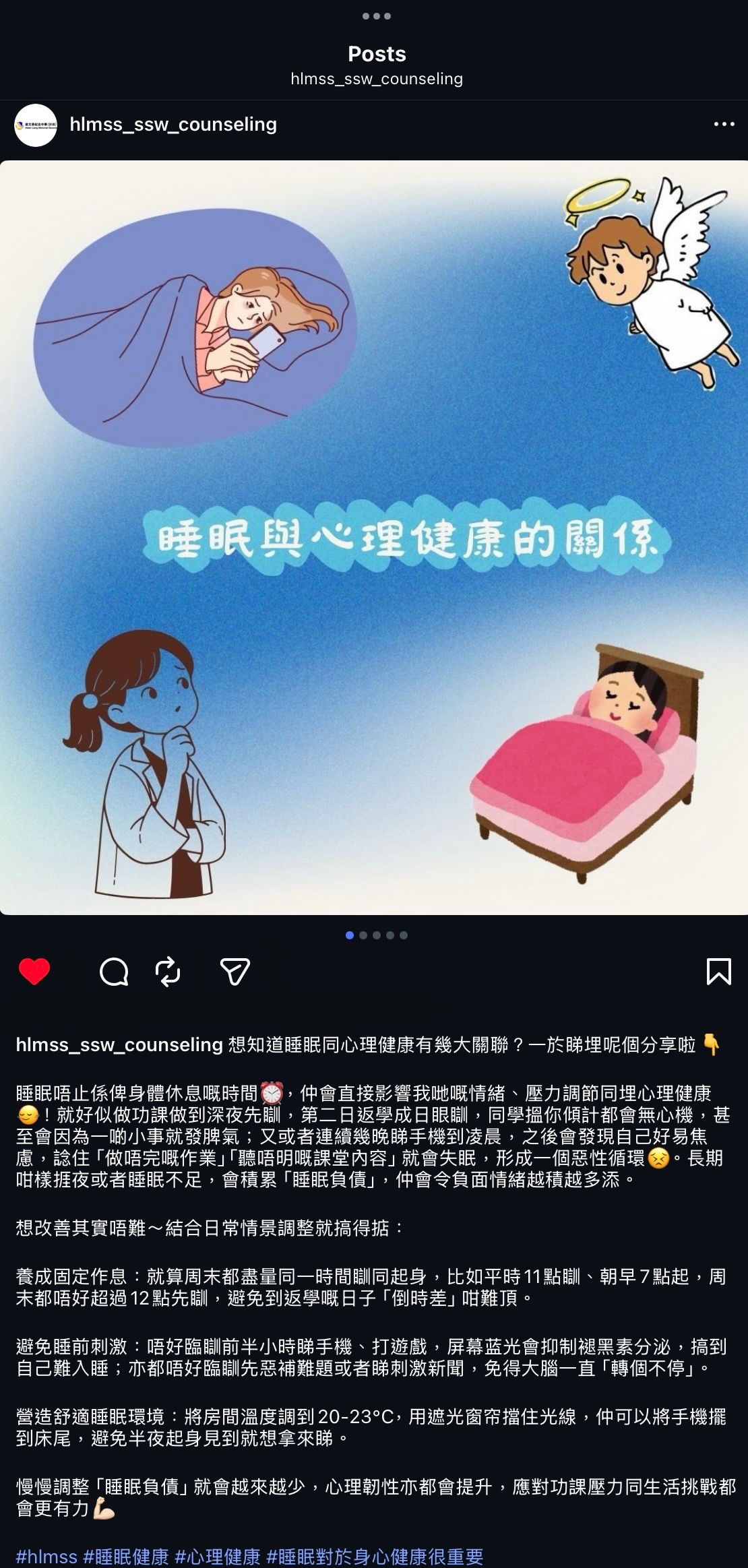
Promotional Services:
This campus promotion centers on the core theme of “Sleep and Mental Health,” focusing on sleep debt through accessible science communication and sharing. Promotion primarily leverages two channels: the school’s Instagram account and the school newsletter. First, we engage students by relating to everyday scenarios, explaining simply that sleep debt is the health debt accumulated from chronic sleep deprivation—small deficits that add up to harm both body and mind. Next, we clearly outlined its specific harms: not only does it cause daytime fatigue and diminished classroom focus, but it also disrupts emotional stability, intensifies anxiety and irritability, and impacts mental health. We hope to use relatable, everyday examples to help students deeply grasp the close connection between sleep and mental health. This understanding will encourage them to prioritize regular sleep and develop healthy sleep habits. Adequate sleep strengthens both physical and mental well-being, enhances psychological resilience, and enables students to better engage in campus learning and life.
School: HKSYC&IA Chan Nam Chong Memorial College
Advocates: Lam Sze Yu, Suen Cho Wing

Promotional Services:
For this “campus promotion,” we featured our internal stress management team—Firefighters vs. Administrators—during the school TV station’s morning assembly broadcast. We explained that when facing stress, we actually have two inner helpers: “Firefighters” immediately extinguish the flames with quick fixes like gaming or snacking, temporarily easing unease; while ‘Administrators’ prompt us to pause, take deep breaths, and rationally consider, “Is this behavior beneficial for me?” Understanding the protective intent behind each behavior, we learn to collaborate with ourselves rather than fight against ourselves, because every inner voice carries goodwill. Everyone possesses the capacity for self-healing. By learning to listen to our inner voices and treat ourselves kindly, inner chaos will eventually give way to clarity and order. Let’s learn together the wisdom of peacefully coexisting with stress! Therefore, we introduced students to some stress management techniques.
School: Ho Lap College (Sponsored By Sik Sik Yuen)
Advocates: Ho Chantal Ka Ki, Siu Pak Lam, Wong Kam Tim
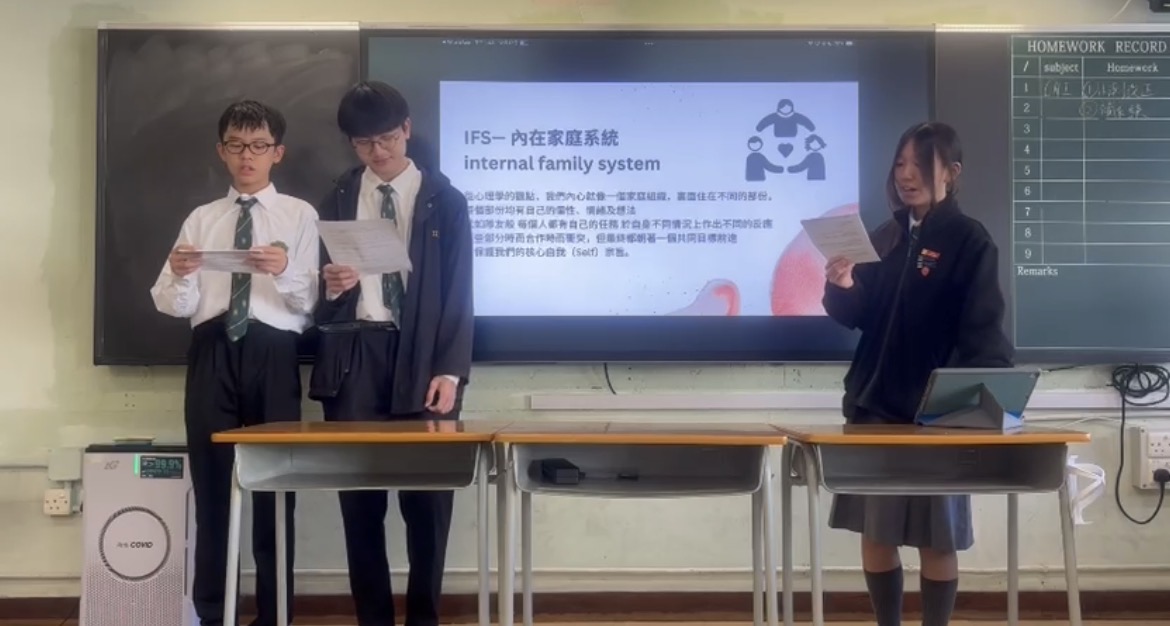
Promotional Services:
This on-campus promotional event is to introduce the concept of IFS (Internal Family System) in psychology. We hope to introduce this concept because we’ve noticed that many students don’t know why they have certain thoughts or emotions, and even feel strange about themselves, which leads them to put themselves down. So we really hope to introduce this concept we learned in this program to them. In fact, we encounter this situation in many everyday scenarios, and it’s closely related to our IFS system. After this promotional period, we also checked in with the different students and found that they really weren’t as resistant to and skeptical of their own feelings as they used to be. We really hope that they will continue to remember this concept in the future, to accept the parts of themselves that are influencing them.
School: SKH Bishop Mok Sau Tseng Secondary School
Advocates: Au Bik Sum, Chau Ka Ying, Fong Wing Yin

Promotional Services:
We are Secondary School Mental Health Ambassadors. Through participating in the “Secondary School Students Mental Health Ambassador Program 2025,” we received professional mental health training, learning how to manage emotions, reduce stress, and improve sleep quality. To share our knowledge with our school community, we designed a special campus outreach event centered on the theme of “sleep debt.” We introduced our peers to the relationship between sleep and stress, the principles of biological clock function, and the impact of sleep deprivation on physical and mental health.
The event featured interactive lectures, case studies, calculation exercises, and self-assessment tools to help students understand their sleep patterns and learn how to calculate their daily sleep debt. We also shared five key strategies for improving sleep quality: avoiding electronic devices, creating a comfortable sleep environment, choosing sleep-promoting foods, reducing caffeine intake, and practicing meditation for relaxation.
Through this initiative, we aim to raise awareness about sleep health, encouraging students to establish regular routines and enhance their quality of life. We believe that by prioritizing sleep starting tonight, everyone can gradually repay their “sleep debt” and move toward a healthier, happier campus life.
School: St. Rose of Lima’s College
Advocates: Lam Sze Ching Kelly, Law Tsz Yau

Promotional Services:
For our campus outreach, we chose to publish an article titled “Mental Growth, Sleep in Tandem” in the school magazine Rosalima No. 12 to raise students’ awareness of mental health and sleep quality. In the article, we first outlined the current situation of secondary school students, helping peers understand the importance of a healthy mental state and quality sleep, while also explaining our motivation for writing this piece. Next, we briefly shared our reflections and insights from participating in a four-day in-person mental health workshop over the summer break, using our personal experiences to inspire others. We then specifically introduced knowledge learned in class: insufficient sleep creates a gap between the “wakefulness rhythm” and “biological rhythm,” forming the concept of “sleep debt.” This concept highlights the impact of inadequate sleep on the mind, body, and spirit. Simultaneously, we provided practical methods to remind students to improve sleep quality and realign their “wakefulness rhythm” and “biological rhythm” through daily habits like scheduling consistent routines and avoiding electronic devices before bed. Concluding the article, we offered a message to all students, encouraging them to start paying attention to their sleep quality today as a crucial step toward maintaining mental well-being. Looking ahead, after this publication is printed and distributed to all students, we plan to produce a promotional video. This video will introduce the article and share mental health knowledge in a more engaging format. It will also be uploaded to the school’s social media platforms to further promote the importance of mental health.